
The Private Equity Guide to AI Due Diligence: Evaluating Automation Readiness, Tech Debt, and Multiple Expansion
A comprehensive buyer-side technical and financial framework for private equity deal teams, operating partners, and strategic acquirers evaluating operational automation, sovereign data integrity, and 4% to 7% post-merger EBITDA margin expansion across lower-middle-market portfolio companies.
1. The Virtual Data Room (VDR) Challenge: High-Velocity AI Ingestion
Manual due diligence across thousands of unstructured contracts, customer agreements, and equipment logs in lower-middle-market M&A ($1M to $50M EV) introduces unacceptable cost, delay, and analytical blind spots for sponsor deal teams.
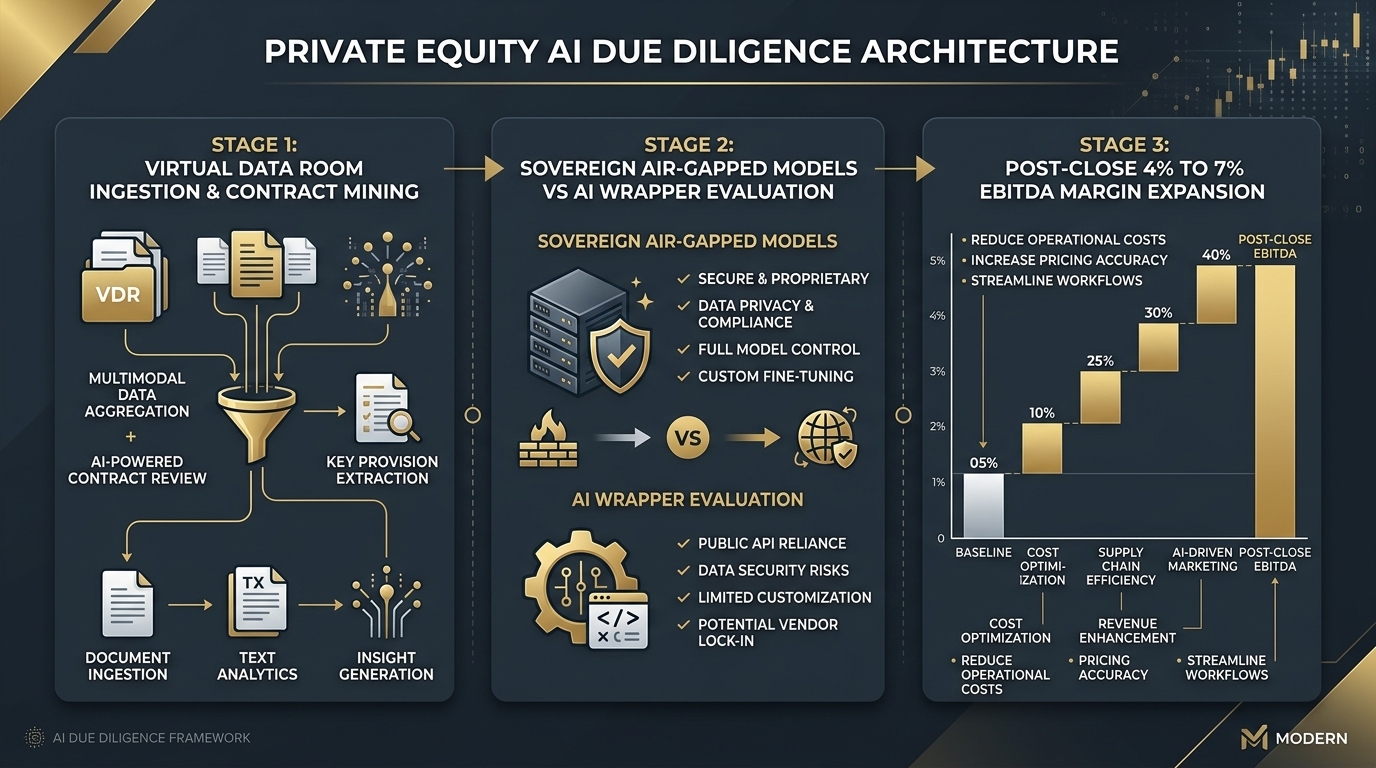
Deploying sovereign, air-gapped LLM models within an isolated VPC allows deal teams to extract structured intelligence across the entire VDR in hours:
- Contractual Risk & Change-of-Control Identification: Instantly flagging non-assignable customer agreements, non-compete expirations, and regulatory change covenants before signing the definitive purchase agreement.
- Customer & Revenue Concentration Verification: Tying invoices and billing databases to uncover unhedged account dependencies that distort perceived Quality of Earnings.
- Air-Gapped Confidentiality: Strict data redaction and zero-retention parameters prevent sensitive LOI valuation structures or proprietary financials from being leaked to public model training sets.
2. Diligence Framework: AI Wrapper vs. Defensible Sovereign Pipeline
Not all automation creates enterprise value. The single most consequential determination during technical due diligence is distinguishing between high-margin proprietary software assets and commoditized API wrappers that collapse under supplier pricing pressure.
Fragile AI Wrapper
Superficial UI layers calling public third-party APIs. Zero proprietary data moats, vulnerable to token pricing spikes, zero customer switching costs, and commands 0x multiple expansion on exit.
Sovereign AI Architecture
Proprietary enterprise models fine-tuned on air-gapped internal data, integrated directly into operational ERPs and dispatch. Expands exit multiples by +0.75x to +1.25x EBITDA.
3. 2026 Lower-Middle-Market AI Valuation Multiples Benchmark
| Target Industry Sector | Baseline EBITDA Multiple | Multiple Expansion Potential | Primary AI Multiple Expansion Drivers |
|---|---|---|---|
| Commercial Facilities & Janitorial | 3.5x – 6.5x | +0.75x EBITDA | Automated dynamic dispatch, supply restocking, automated inspection QA. |
| HVAC & Climate Control | 4.0x – 7.5x | +1.00x EBITDA | Predictive telemetry, automated membership renewals, route density optimization. |
| Plumbing & Piping Contractors | 3.8x – 7.0x | +0.75x EBITDA | AI voice intake for after-hours emergency calls, automated parts inventory forecasting. |
| Electrical Contracting | 4.0x – 7.2x | +0.85x EBITDA | Estimating automation from blueprint PDFs, safety compliance record extraction. |
| B2B Industrial & Manufacturing | 4.5x – 7.0x | +1.25x EBITDA | Edge-deployed computer vision QA, dynamic raw material procurement, predictive machine maintenance. |
| Healthcare, Dental & Veterinary DSOs | 5.5x – 9.0x | +1.25x EBITDA | Autonomous billing reconciliation, patient recall agents, insurance pre-authorization automation. |
Private Equity Deal Team Takeaway
In an acquisition priced at 6.0x EBITDA on $3M in target cash flow ($18M EV), identifying a 5% margin expansion ($150,000 incremental EBITDA) and lifting the exit multiple by +1.0x (to 7.0x) yields an incremental $4.05M in enterprise value creation at exit.
4. The 100-Day Post-Close Value Creation Roadmap
Capturing the full 4% to 7% EBITDA margin recovery requires disciplined sequence execution across the portfolio company's first 100 days of ownership.
Days 1–30: Workflow Telemetry & Knowledge Audit
Audit existing software seats, map unstructured communication channels (Slack, email, ERP notes), and identify the top 3 repetitive administrative bottlenecks causing employee overtime.
Days 31–60: Sovereign Ingestion & Dispatch Automation
Deploy private, air-gapped LLM pipelines to ingest historical customer records, warranties, and supplier catalogues. Automate inbound request triage, dispatch schedules, and inventory lookup.
Days 61–80: Revenue Cycle & Billing Reconciliation
Connect automated agents to accounting and CRM systems to eliminate billing lag, automatically resolve unbilled change orders, and flag delinquent accounts receivable before cash conversion cycles stall.
Days 81–100: Multiple Expansion Hardening & Playbook Codification
Formalize proprietary workflow software as defensible company IP, document repeatable efficiency gains in executive board presentations, and prepare normalized run-rate EBITDA reporting for next-round financing.