
The Buy-Side Search Fund & Private Equity Acquisition Playbook
A complete operational manual for search fund entrepreneurs, independent sponsors, and private equity deal teams sourcing, structuring, and closing acquisitions between $5M and $30M in enterprise value.
1. Search Fund Models: Traditional vs. Self-Funded vs. Independent Sponsor
The lower middle market represents the most inefficient and lucrative segment of North American M&A. Over 10,000 baby-boomer-owned businesses reach retirement age daily, creating an unprecedented wave of business succession opportunities. Buyers navigating this landscape generally organize under one of three structural frameworks:
Traditional Search Fund
Raises $400k–$600k from institutional search fund investors for a 24-month search phase. Targets $2M–$5M EBITDA ($10M–$30M EV). Searcher earns 20%–30% common equity earn-in across performance milestones.
Self-Funded Searcher
Self-financed search targeting $1M–$3M EBITDA ($4M–$12M EV). Utilizes SBA 7(a) senior debt (up to $5M) alongside seller notes, retaining 70% to 90%+ common equity ownership upon close.
Independent Sponsor
Sources proprietary transactions ($3M–$10M+ EBITDA / $15M–$60M EV) before securing debt and equity capital on a deal-by-deal basis from family offices and private credit funds. Retains 15%–25% carried interest / promote.
2. Proprietary Deal Sourcing: Beating the Brokered Auction
Direct-to-owner proprietary sourcing bypasses competitive investment banking auctions, capturing businesses at 1.5x to 3.0x lower EBITDA multiples with superior deal structure flexibility.
While brokered listings from national M&A advisories provide complete data rooms, they create hyper-competitive auctions where private equity platforms drive multiples past 8.0x EBITDA. For individual searchers and boutique sponsors, proprietary direct outreach generates off-market exclusivity.
- Narrow Thesis Definition: Selecting 2–3 resilient B2B sub-sectors (e.g., commercial HVAC maintenance, mission-critical testing/inspection, specialized compliance software) with low cyclicality and high recurring revenue.
- Founder-Empathetic Narrative: Positioning the searcher as an energetic operator who will protect the founder's legacy, preserve the existing team, and relocate locally—contrasting sharply with financial cost-cutters.
- Intermediary Cultivation: Partnering with regional transaction advisors, wealth managers, and estate attorneys who maintain pre-existing trusted relationships with retiring shareholders.
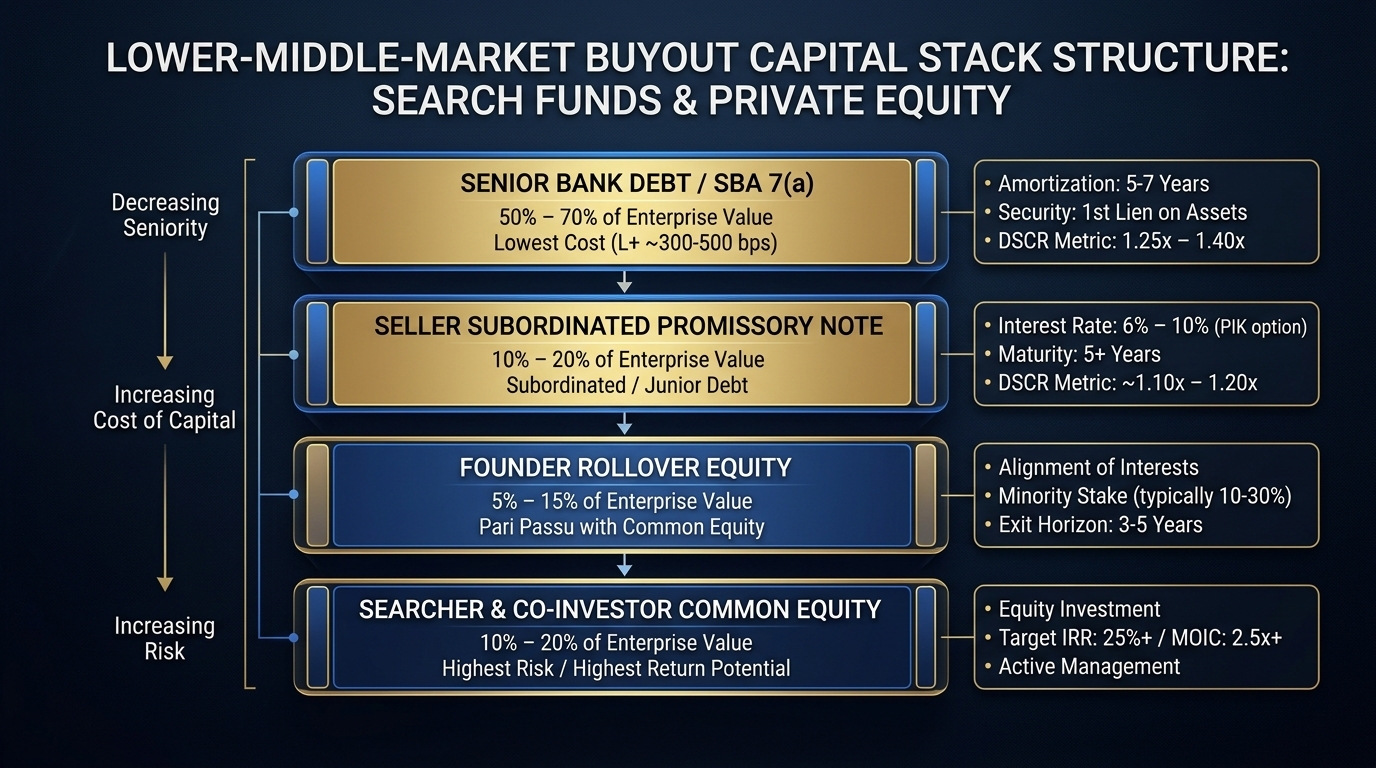
3. The Lower-Middle-Market Capital Stack: Structuring the Buyout
| Capital Layer | % of Total Capital | Typical Interest / Cost | Subordination & Terms |
|---|---|---|---|
| SBA 7(a) / Senior Bank Debt | 50% – 75% | Prime + 2.0% to 3.0% (floating) | Senior lien on all business assets; 10-year fully amortizing term. |
| Seller Financing (Promissory Note) | 10% – 20% | 6.0% – 9.0% (fixed) | Subordinated to senior bank debt; 3-to-7 year term; balloon or amortizing. |
| Rollover Equity (Founder) | 5% – 15% | Pari passu common equity | Founder retains equity; aligns incentives for post-close transition. |
| Searcher & Investor Equity | 10% – 20% | Cost of Equity (25%+ Target IRR) | Cash equity injected at closing to fund remaining purchase price & working capital. |
SBA 7(a) Standstill Rule for Equity Injection
Under SBA regulations, a seller note can satisfy up to 50% of the minimum 10% equity injection requirement (allowing the buyer to inject only 5% cash), provided the seller note is placed on full payment standstill (no principal or interest payments) during the 10-year life of the SBA loan, or structured as an approved subordinated debt instrument post-24 months.
4. Letter of Intent (LOI) Engineering & Confirmatory Due Diligence
The LOI locks the transaction price and provides 60 to 90 days of exclusive confirmatory due diligence across financial, legal, commercial, and operational domains.
5. The 5-Step Acquisition Process
Target Criteria Definition & Direct Sourcing
Define acquisition thesis ($1M–$5M EBITDA, B2B services/software, low customer concentration) and execute multichannel outreach across intermediary networks and direct-to-owner campaigns.
Initial Screening & Financial Normalization
Review Confidential Information Memorandums (CIMs), build initial valuation models, calculate preliminary Adjusted EBITDA, and establish price expectations.
LOI Engineering & Exclusivity Negotiation
Structure headline purchase price, working capital targets, earnout thresholds, seller note financing terms, and secure 60-to-90 days of exclusive due diligence.
Confirmatory Diligence & Capital Syndication
Commission third-party Quality of Earnings (QofE), legal review, and tech diligence while securing SBA 7(a) senior debt, mezzanine financing, and equity commitments.
Purchase Agreement Execution & Integration
Draft Asset Purchase Agreement (APA) or Stock Purchase Agreement (SPA), fund the capital stack, execute closing escrows, and initiate the 100-day post-acquisition transition plan.