
The 100-Day Pre-Sale Preparation & Exit Planning Checklist
A comprehensive execution blueprint for lower-middle-market business founders, private equity operating partners, and majority shareholders preparing to maximize enterprise valuation and eliminate diligence deal friction.
The Economic Cost of Going to Market Unprepared
In lower-middle-market M&A, the Letter of Intent (LOI) is not the finish line—it is the starting gate of intense transactional scrutiny. Once an LOI is executed and exclusivity is granted, the buyer’s leverage peaks while the seller’s pricing power declines precipitously. Financial sponsors deploy specialized third-party forensic accounting teams to conduct exhaustive Quality of Earnings (QofE) analyses with one explicit objective: discovering margin erosions, unrecorded liabilities, and aggressive add-backs to re-trade the enterprise purchase price.
By proactively running an internal 100-day pre-sale audit, founders shift from a defensive posture to an offensive institutional stance. Every dollar of EBITDA normalized, contract assigned, and workflow codified translates directly into cash at close at a 5.0x to 10.0x multiple.
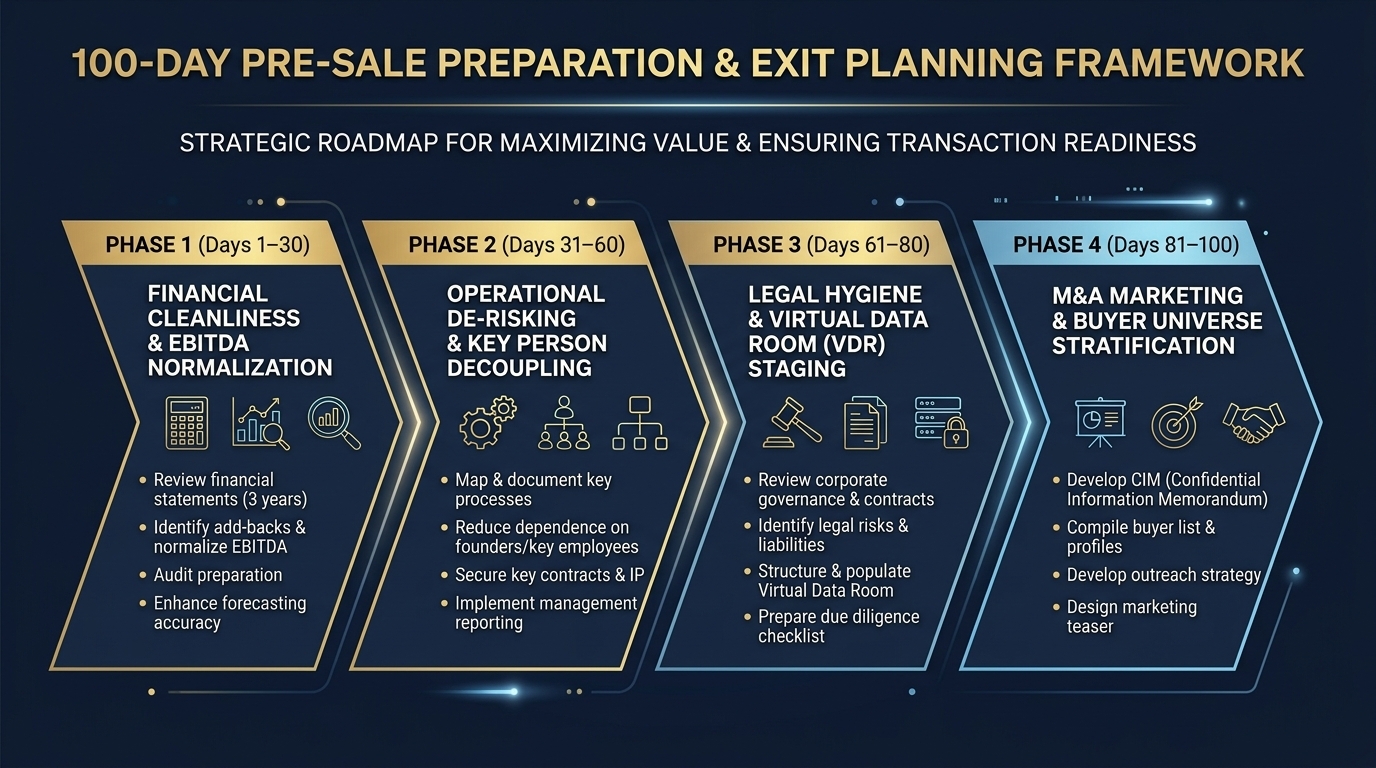
The foundation of maximum valuation is auditable, defensible adjusted EBITDA. Phase 1 dismantles tax-minimization accounting and establishes clean, GAAP-aligned institutional reporting.
Acquirers buy future cash flows that survive the seller’s departure. Phase 2 transitions operational dependency from the founder into a durable, scalable management architecture.
Pre-Sale Due Diligence Friction & Valuation Impact Matrix
| Diligence Friction Point | Typical Buyer Reaction | Valuation / Structural Impact | 100-Day Pre-Sale Remediation |
|---|---|---|---|
| Customer Concentration (>25% Single Account) | Demands contingent earnouts, increased rollover equity, or price cut. | -1.0x to -2.0x EBITDA multiple discount | Lock customer into 3-year Master Services Agreement with assignability clause. |
| Founder-Centric Sales & Technical Delivery | Requires 2-to-4 year employment agreement and non-compete earnout. | 30%–50% of consideration locked in post-close escrows | Promote internal director, transition customer accounts, and codify operating playbook. |
| Unsubstantiated EBITDA Add-Backs | Disallows add-backs during buyer QofE audit; forces re-trade. | Direct reduction of Enterprise Value ($1M add-back cut = $6M–$8M value loss) | Compile invoices, general ledger entries, and obtain sell-side QofE sign-off. |
| Unassigned IP & Offshore Contractor Code | Demands high special indemnity escrows (15%–25% of purchase price). | Escrow holdbacks increased; deal closing delayed 60+ days | Execute retroactive IP assignment agreements and verify clean code provenance. |
| Commingled Accounts & Related-Party Leases | Suspicion of off-balance-sheet liabilities and unrecorded expenses. | Buyer requires extended representations & warranties survival periods | Separate entities, commission formal fair-market lease appraisal, clean general ledger. |
Institutional M&A Principle: Time Kills All Deals
Every week a transaction is extended in confirmatory due diligence increases the probability of external shocks: macroeconomic shifts, key employee departures, customer churn, or buyer fatigue. Companies that arrive at market with a fully populated Virtual Data Room and verified QofE close 45 days faster and experience 70% fewer re-trades.
Unresolved legal entanglements and unassigned intellectual property provide buyers with contractual ammunition to demand escrow holdbacks and punitive indemnity caps.
The final 20 days crystallize the company’s forward equity narrative and establish a disciplined, competitive bidding framework.