
The Quality of Earnings (QofE) & EBITDA Add-Back Master Playbook
An institutional guide to defining, defending, and negotiating EBITDA normalizations in lower-middle-market M&A. How sellers protect millions in enterprise value and how private equity buyers verify sustainable run-rate earnings.
QofE Report vs. Financial Audit: The Critical Difference
Many founders mistakenly assume that having audited or reviewed financial statements protects them during a business sale. However, a financial audit looks in the rearview mirror to verify compliance with US GAAP rules. It does not evaluate whether an extraordinary customer contract is about to expire, whether executive salaries reflect fair market value, or how gross margin behaves across product lines.
Private equity buyers and search funds hire transaction advisory practices (Big 4 or national boutique accounting firms) to conduct buy-side QofE reports. Their goal is straightforward: test the seller's reported Adjusted EBITDA and uncover items that can be removed to reduce the headline purchase price prior to closing.
The 5 Pillars of EBITDA Normalization
Adjusted EBITDA bridges reported net income to sustainable operating cash flow across five distinct categories:
Owner Compensation Normalization
If an owner-operator draws $800,000 annually but a replacement CEO could be hired for $300,000, the $500,000 variance is added back to EBITDA. Conversely, zero or sub-market salaries require negative adjustments.
Extraordinary & Non-Recurring Costs
Legitimate historical expenses that will not recur under new institutional ownership: litigation defense legal fees, severance packages from a closed division, or one-time facility repair costs.
Pro Forma Run-Rate Adjustments
Reflects structural revenue or cost changes that occurred mid-year as if active for the entire trailing twelve months (TTM), such as an annualized major enterprise SaaS contract signed in Q3.
Related-Party Leases & Transactions
Adjusts rent paid to founder-owned real estate LLCs to fair market value (FMV). Any above-market rent paid is added back to EBITDA; below-market rent results in a required negative deduction.
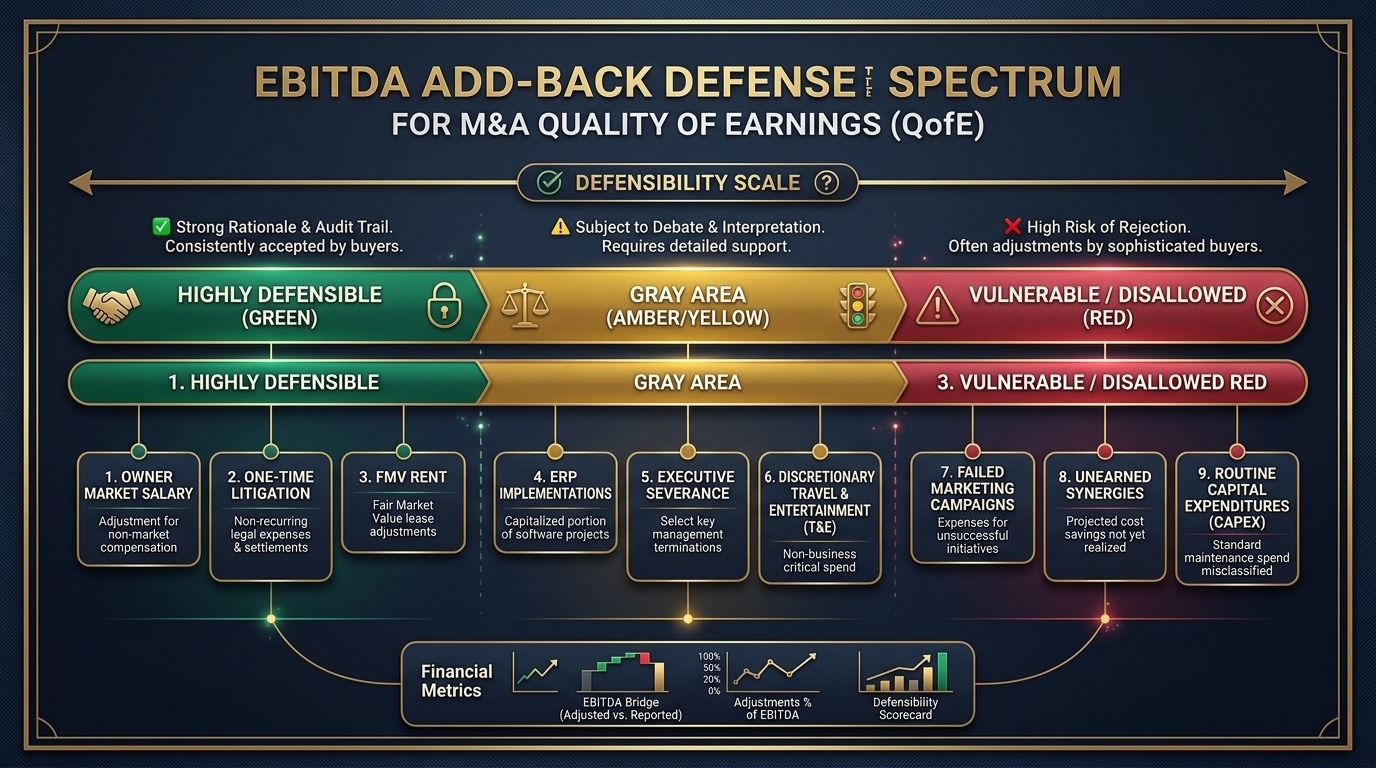
The Defensibility Spectrum: Defensible, Gray Area, and Vulnerable Add-Backs
| Adjustment Item | Defensibility Tier | Required Substantiation | Buyer Scrutiny / Haircut Risk |
|---|---|---|---|
| Owner W2 Above-Market Compensation | Defensible | Executive compensation study & third-party recruiting comps | Low (if verified with third-party salary data) |
| Discretionary Personal Travel & Auto | Defensible | Itemized general ledger transactions, fuel cards, lease records | Low (readily accepted with clean GL itemization) |
| One-Time Facility Relocation / Lease Break | Defensible | Executed settlement agreement, moving contractor invoices | Low (isolated non-recurring operational event) |
| Defended Patent / Trade Secret Litigation | Defensible | Law firm billing records, court dismissal documentation | Low to Moderate (buyer verifies litigation is extinguished) |
| ERP / CRM Implementation Consulting | Gray Area | Software implementation SOWs, milestone invoices | Moderate (software maintenance fees remain operating expense) |
| Severance & Executive Departure Costs | Gray Area | Separation agreements, severance payroll documentation | Moderate (buyer checks whether replacement was hired) |
| Unrealized Commercial Synergies | Vulnerable | Internal management financial pro forma models | High (consistently disallowed by institutional PE buyers) |
| Failed Marketing Campaign Expenses | Vulnerable | Agency invoices, ad platform receipts | High (marketing is a recurring operational necessity) |
| Routine Capital Expenditures Treated as R&M | Vulnerable | Invoices for machinery repairs or IT hardware purchases | High (reclassified to CapEx; reduces free cash flow) |
The Financial Multiplier Effect: Why Add-Back Precision Matters
In a transaction priced at a 7.5x EBITDA multiple, every $100,000 of validated add-backs delivers $750,000 in immediate gross proceeds to the seller. Conversely, if a buyer’s QofE disallows $400,000 of aggressive add-backs, the enterprise valuation drops by $3,000,000. Maintaining audit-ready proof before entering exclusivity is the most valuable preparation work an owner can perform.
How Sell-Side QofE Prevents Diligence Re-Trading
When a buyer presents a Letter of Intent based on unverified internal financial statements, they often include a caveat that the purchase price is subject to confirmatory diligence. During the 60-day exclusivity window, their forensic CPAs scrutinize every ledger entry. If they uncover questionable items, the buyer has immense psychological leverage to demand an eleventh-hour valuation discount.
The Baseline Is Locked
Bidders evaluate and submit LOIs based on pre-vetted, defensible Adjusted EBITDA numbers, eliminating arbitrary valuation haircuts.
Diligence Speed Accelerates
The buyer’s QofE team validates an existing institutional report rather than starting from scratch, cutting diligence timelines from 75 days to under 35 days.
Surprises Are Neutralized
Seasonality issues, customer concentration risks, and gross margin fluctuations are framed strategically on the seller's terms before buyers uncover them.
Auction Leverage Maintained
Pre-cleared financials permit simultaneous review across multiple private equity bidders, preventing exclusivity renegotiations.